Language:



Product Introduction
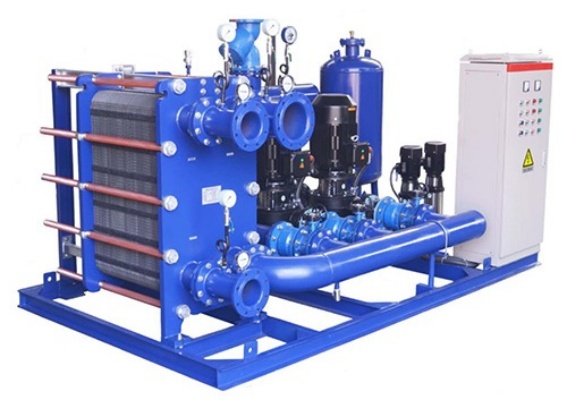
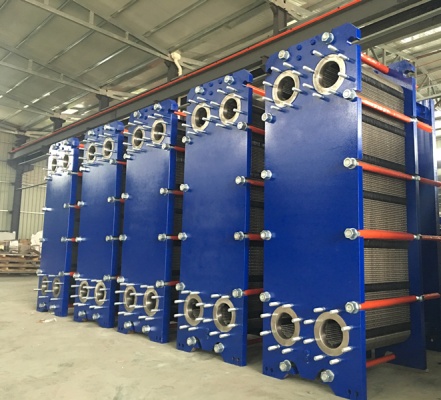
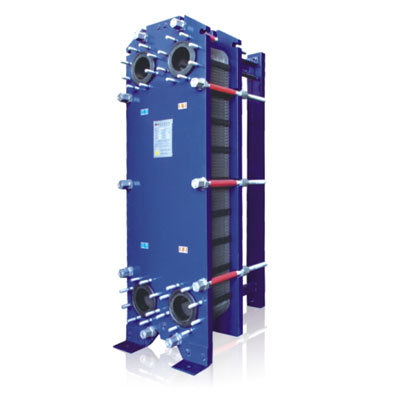
Plate Heat Exchanger, PHE, is an efficient and compact heat transfer device. Its core consists of a stack of corrugated metal plates. Thin rectangular channels are formed between plates, where hot and cold fluids flow alternately to realize heat transfer.
Key Features
1. High heat transfer efficiency
2. Compact structure & small footprint
3. Flexible and adjustable
4. Easy to clean and maintain
5. Excellent sealing performance
6. Limitations
Main Applications
|
Application Field |
Typical Operating Conditions |
|
HVAC |
district heating / cooling, building air conditioning systems, ice thermal storage, ground-source heat pumps |
|
food & beverage |
milk pasteurization, juice cooling, beer brewing, edible oil heating |
|
chemical & pharmaceutical industries |
reactor temperature control, solvent recovery, crystallization process, API cooling |
|
power & energy |
closed-circuit cooling in power plants, waste heat recovery, solar hot water systems |
|
marine & offshore |
main engine cooling, fresh water generator, lube oil cooling |
|
metallurgy & machinery |
quenching liquid cooling, hydraulic oil cooling, rolling mill lube oil cooling |
|
paper & textiles |
bleaching liquor heating, dye cooling, wastewater waste heat recovery |
|
refrigeration |
evaporators, condensers, economizers (e.g. ammonia refrigeration systems) |
Common Types
|
Type |
Feature |
Applicable Scenario |
|
Gasketed Plate Heat Exchanger |
Plates can be removed for cleaning, enabling easy maintenance. |
Service conditions prone to scaling and demanding frequent cleaning. |
|
Brazed Plate Heat Exchanger |
Copper/nickel brazed sealing, gasket-free, capable of withstanding high pressure. |
Refrigerant systems, small flow and high pressure conditions. |
|
Fully Welded Plate Heat Exchanger |
Laser / TIG welded construction, gasket-free, resistant to high temperature and high pressure. |
High temperature, corrosive media and high pressure working condition |
|
Semi-Welded Plate Heat Exchanger |
Plate pairs welded + sealing gaskets, combining the advantages of both designs |
Ammonia refrigeration, hazardous media service |
Selection Key Points
Comprehensive considerations for selection:
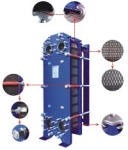
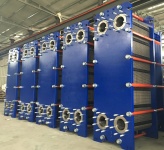
Plate Heat Exchanger
 |
 |
 |
 |
Advantages and Features of Plate Heat Exchanger
● high heat transfer efficiency & low end temperature difference
Heat transfer is realized via full counter-flow design, enabling an end temperature difference as low as 1℃.
● safe, reliable operation & easy maintenance
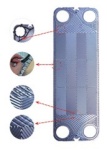
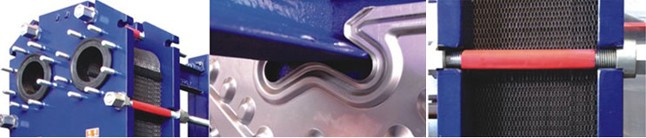
Two layers of sealing gaskets are arranged below the corner holes, together with tell-tale holes, to prevent mixing of the two media.
● glue-free gasket design
The roof-shaped gasket adopts a glue-free snap-fit structure. The fixing and sealing functions are separated. It ensures reliable sealing while facilitating convenient disassembly, assembly and replacement.
● reasonable & efficient flow distribution area
It evenly distributes flow velocity and eliminates stagnant flow zones, avoiding corrosion caused by particle accumulation. Meanwhile, it improves the utilization rate of plate heat transfer area and greatly boosts heat exchange efficiency.
● low fouling tendency & cost-effective
Uniform intense turbulence of the fluid provides a self-cleaning effect that inhibits particle accumulation.
● flexible plate combination configuration
Large-angle and small-angle plates of the same model can be combined according to various heat transfer conditions to achieve optimal heat transfer performance within allowable pressure drop.
● alternate wide & narrow channels for same model
A wide range of plate patterns are available to satisfy diverse working conditions and deliver excellent heat transfer efficiency.
● four-corner interlocking positioning structure
Interlocking positioning structures are arranged at four corners of plates, improving reassembly performance and enabling higher operating pressure resistance.
● five-point positioning system
Three positioning points on the upper guide bar and two points on the lower guide bar. Plates can be perfectly reset after disassembly and assembly with accurate gasket sealing, enhancing service performance and pressure resistance.
● one-way clamping tie rod system
Adopts one-way clamping tie rods for uniform compression of plates to ensure consistent and reliable sealing.
● low fouling tendency & easy maintenance
The movable compression plate is equipped with a self-locking mechanism. Only one operator with simple tools can disassemble and assemble the heat exchanger easily on-site.
Gasketed Plate Heat Exchanger
 |
 |
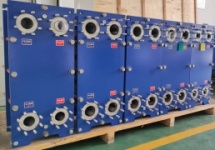 |
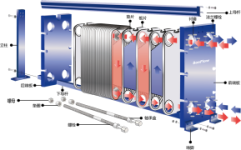
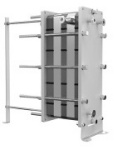
Plate heat exchangers consist of a set of corrugated metal plates. Each plate is provided with four corner holes for the passage of two heat-exchanging fluids (liquid or gas).
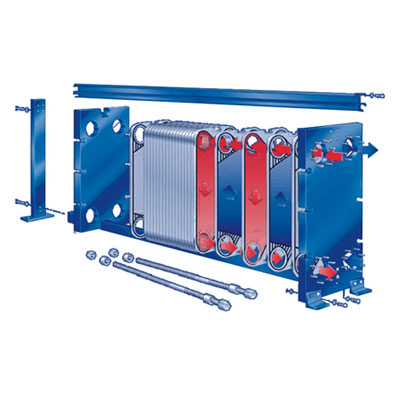
The metal plates are assembled in a frame fitted with a fixed plate and a movable compression plate on one side, and tightened by clamping bolts. Sealing gaskets are mounted on the plates to seal the fluid channels and guide the two fluids to flow alternately into their respective passages.
The corrugated plates not only increase the turbulence level of the fluid, but also form numerous supporting points capable of withstanding the pressure difference between media.
The metal plates and movable compression plate are suspended on the upper guide bar and positioned by the lower guide bar, whose both ends are fixed on support columns.
Assembly is carried out with fully automatic electric hydraulic wrenches, which greatly improves production efficiency and product quality, enabling customers to receive high-quality plate heat exchangers within the shortest lead time.
Common Materials
|
Plate Material |
Applicable Fluid |
|
Stainless Steel (AIS1304. AIS1316) |
clean water, river water, edible oil, mineral oil, alcohol |
|
Titanium & Titanium-Palladium Alloy |
seawater, brine, saline media |
|
20Cr. Rs-2. SM0254 |
dilute sulfuric acid, dilute sulfate aqueous solutions, inorganic aqueous solutions |
|
Nickel (Ni) |
high-temperature, high-concentration caustic soda |
|
HASTELLOY(C276、D205、B2G) Alloy |
concentrated sulfuric acid, hydrochloric acid, phosphoric acid |
|
Graphite |
hydrochloric acid, medium & concentrated sulfuric acid, phosphoric acid, hydrofluoric acid |
Design
Pressure:2
5 Mpa
Design Temperature:-20℃"200℃
Plate materials and gasket materials can be flexibly selected according to operating process conditions.
|
Gakset Material |
Operating Temperature |
Applicable Fluid |
|
NBR |
-15℃ ~ +110℃ |
water, seawater, brine & mineral oil |
|
HNBR |
-15℃~ +140℃ |
high temperature mineral oil |
|
EPDM |
-25℃ ~ +180℃ |
hot water, steam, acids & alkalis |
|
VITON |
-15℃ ~ +200℃ |
strong acid/alkaline fluids |
Brazed Plate Heat Exchanger
 |
 |
 |
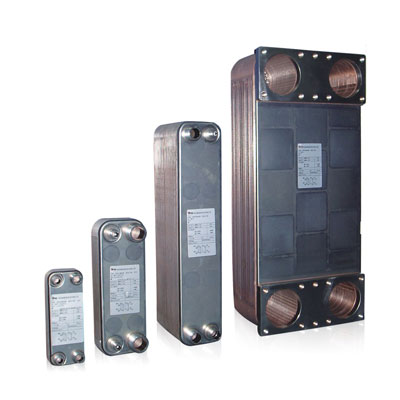
Brazed Plate Heat Exchanger
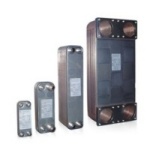
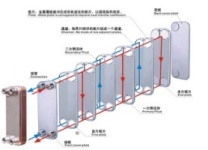
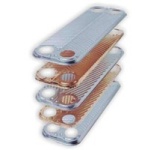
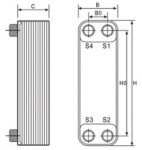
The brazed plate heat exchanger consists of multiple stainless steel corrugated plates and front & rear end covers. High-purity copper foil (or nickel foil) is used as brazing filler between plates, and the whole unit is integrally brazed in a vacuum high-temperature furnace. According to actual working conditions, high, medium and low flow heat transfer plates can be flexibly combined to achieve optimal heat exchange performance, with an overall heat transfer coefficient ranging from 3000 to 12000 W/(㎡·K). Featuring no gaskets and no external frame, the equipment boasts a compact structure and can operate continuously under long-term high temperature and high pressure working conditions.
|
Main Applications heat pump units chiller units waste heat recovery heating and cooling of lubricating oil and other fluids heating and cooling of compressed gas and other gases heating and cooling of high-purity water for medical, food, electronics ammonia refrigeration boiler / steam other industrial applications |
 |
Five Major Features of Brazed Plate Heat Exchanger

Technical Parameters
|
Pressure |
Temperature |
Plate |
Brazing Material |
Connection |
|
30/45bar |
-20'C-300'C |
AISI316L |
Copper or Nickel |
Thread, welding, flange, etc |
Application Fields
|
chemical industry alkali liquor cooling/ acid liquor cooling/ chlorine solution cooling/ brine preheating/ potassium carbonate solution cooling/ process heating; soda ash industry/ synthetic ammonia/ alcohol fermentation/ resin synthesis cooling, etc. |
food & beverage raw fruit juice heating/ carbonated fruit juice heating/ syrup heating/ fruit pulp heating/ pasteurization and cooling of milk/ papain heating and cooling/ heating and cooling of various liquors |
|
oleochemicals paraffin cooling/ soap solution cooling/ mineral oil cooling/ lactone solution cooling/ shampoo cooling/ paint manufacturing process cooling/ atmospheric drying/ heating or cooling of soap base/ various process fluids/ etc. |
electronics & machinery machine cooling/ emulsion cooling/ hydraulic oil cooling/ grinding oil cooling/ kiln water cooling/ transmission oil cooling/ evaporator water cooling/ engine coolant cooling/ heat recovery |
|
textile & paper industry wastewater cooling/ washing water cooling/ wastewater heat recovery/ wood pulp concentration/ cooling of viscose alkali aqueous solution/ cooling of boiling nitrocellulose/ etc. |
surface treatment heating and cooling of electrolyte and electroplating solution/ electroplating solution cooling/ degreasing solution heating/ phosphating solution heating/ paint cooling |
|
automotive industry quenching oil cooling/ paint cooling/ heating and cooling of phosphate treatment solution |
oil heating & cooling mold cooling/ continuous caster cooling/ hydraulic oil cooling/ boiler water cooling/ coking plant water cooling/ emulsion cooling/ ammonia solution cooling/ machine coolant cooling/ compressor coolant cooling/ feed water cooling |
|
steel industry mold cooling/ continuous caster cooling/ hydraulic oil cooling/ boiler water cooling/ coking plant water cooling/ emulsion cooling/ ammonia solution cooling/ machine coolant cooling/ compressor coolant cooling/ feed water cooling |
pharmaceutical & healthcare emulsion cooling/ suspension heating/ plasma heating/ citric acid heating/ infusion cooling/ boric acid solution heating/ antibiotic liquid heating/ starch liquid heating |
Contact: Mr. Liang
Phone: +86 13500015726
Tel: +86 20 87025847
Email: gzkechao@163.com
Add: Room 1605, C3 Building Wanda Plaza, No.87 Kefeng Rd., Huangpu District, Guangzhou, 510530, P.R.China